

What is a preliminary design in architecture
- our projects
- /
- tales
- /
A preliminary design: inspiring and bright beginnings
Beginnings are not easy, that is true, but at Piano Piano Studio we are excited to deploy all the necessary tools to start imagining the dream space of those who come to the studio and place their trust in us.
At the start of the process, there is that intoxicating feeling that everything is allowed, that everything is possible. However, nothing could be further from the truth. The apparent infinity of solutions can even be overwhelming. Little by little, this idea fades as constraints begin to appear. And it is precisely at this point that the real work begins: these constraints become the foundation on which the project starts to take shape and mark the true beginning of the preliminary design phase.
Even so, we will not lie: it is thanks to this initial illusion of magic that we begin each process with so much energy and expectation, which is what makes each project truly unique. In private projects, we try to convey from the very first meeting that we are designing a home with a name and a surname, conceived for specific people and their unique conditions.
That feeling that everything fits “like a glove” is essential to us, and we want it to emerge already at the preliminary design stage.
A working team to shape the preliminary design
At Piano Piano Studio, understanding the level of involvement that the client wishes to have in the project is essential in order to properly plan the design process.
All clients are welcome: some prefer to be involved in every decision, while others choose a more observational role. In any case, our goal is to form a collaborative working team. We establish an open dialogue, neither imposing nor one-sided, but rather a reasoned exchange through which the project is gradually shaped together.
Each stage is discussed and justified, always seeking a balance between technical criteria and the client’s personal expectations.
Preliminary design of a house: the beginning of a relationship
Once the future homeowners choose us as the architectural studio to develop their house project, the first step is to establish a relationship of trust: the contract. This initial agreement allows both parties to feel comfortable and protected from the very beginning. It is a necessary and positive starting point, in which we define timelines, fees, work phases, and all the essential aspects needed to begin calmly.
This initial moment also gives us the opportunity to explain how we work, what to expect from us at each stage, and how we approach communication throughout the process: the Piano Piano methodology.
The imaginary as the starting point of a preliminary design
We have dreamed, we have established the relationship, and we have defined the level of involvement. Now the preliminary design truly begins: it is time to build the imaginary.
At Piano Piano Studio, we take on with great responsibility the dual task of mapping out an imaginary—the foundation from which the preliminary design will emerge.
On the one hand, we listen to and interpret the ideas and needs of our clients, who always arrive with their own imaginary: references, sensations they wish to experience, required surface areas for each space, or the available budget. Many also come with a prior notion of what they understand architecture to be, whether through styles, trends, or images seen on social media.
On the other hand, we gather the necessary regulations for each project and begin the work of organising and prioritising all the thoughts, references, and needs placed on the table.
With all this, the aim is to generate a single guiding thread supported by strong pillars: a shared imaginary.
This shared imaginary not only helps us find a balance between what is possible and what is desired, but also provides a solid foundation that allows us to trust the design process we are developing and to return to it in moments of doubt or uncertainty, helping us find the best solutions.
Understanding the preliminary design as a learning phase
It is during the preliminary design stage that we guide and shape the client’s understanding of architecture through reasoning and coherence, encouraging them to move away from passing trends. And if we do refer to them at any point, they must always have a solid rationale in order to be coherently integrated into the process.
It is a real achievement when future inhabitants begin to internalise our dynamics and immerse themselves in our methodology. There are moments when they even correct themselves, and the proposals they bring become increasingly consistent and aligned with the project’s logic.
It is especially rewarding when a client ends up speaking about domestic functions or well-being instead of predefined forms, or about sensations and textures rather than materials. This shift shows that they have understood the essence of the architecture we propose.
The documentation that makes up a preliminary design
The preliminary design is the first tangible step that transforms ideas and expectations into a concrete and well-founded architectural project.
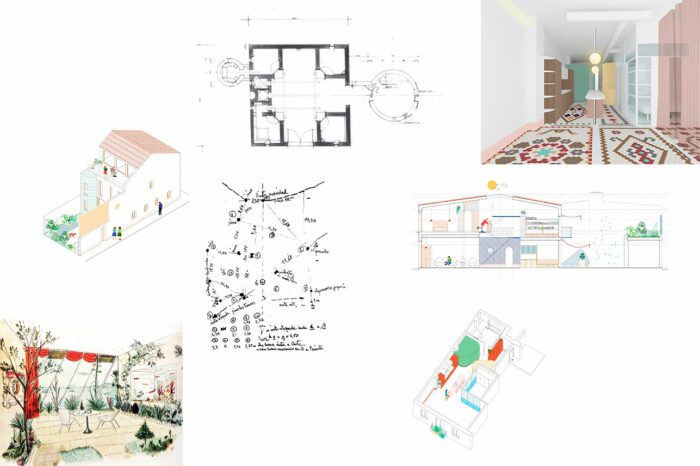
First of all, we prepare an initial approximate cost and area estimate to ensure the project’s viability. Once a comfortable figure is reached, we begin to develop schematic drawings: layout plans, sections, and elevations. These drawings are reinforced with volumetric studies or models that allow the overall form of the space to be visualised and understood. It is also at this stage that we begin to outline the first structural and constructive criteria.
In conclusion, we like to emphasise that the preliminary design is an essential step to reassure both the client and ourselves that the project is viable and that a solid framework has been established, allowing us to move forward into more detailed and definitive phases.