

Combining Materials in Architectural Projects
- inspiration
- /
- tales
- /
Where Does the Combination of Materials Begin?
Everything begins in the imagination. When we work with private clients, they arrive at the studio with their own vision, and we accompany them, step by step, as that vision gradually takes shape.
After an extremely rigorous analysis of needs, existing constraints, regulations and budget, we begin drawing the lines that will define the future spaces of the home. These lines gradually become two-dimensional plans.
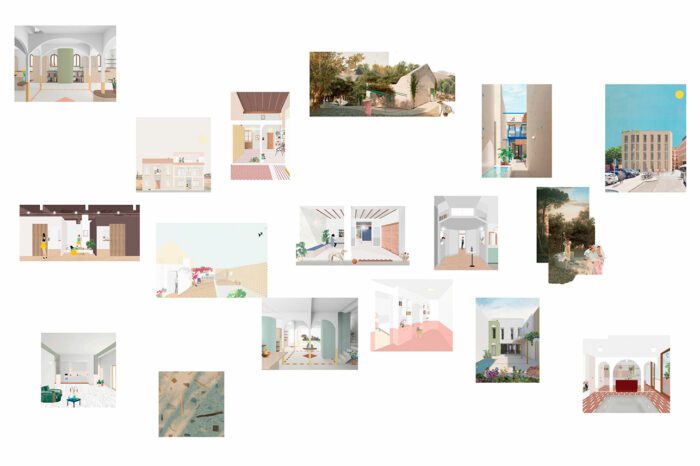
Those lines then acquire thickness, colour and texture, gradually weaving together a drawing that is both balanced and coherent. It is at this stage that we begin to distinguish what is important from what is secondary, what is necessary from what is essential, what brings light and what takes it away.
For this reason, this initial phase is one of the most important stages in achieving a successful final result. The colours, line weights and textures represented in the drawings are not arbitrary choices; they are the catalysts of what is yet to come.
Combining Materials with a Timeless Wardrobe
The working group formed by clients and architects continues to move forward through the architectural process. Once the spatial layout has been defined and the structure, building systems and construction details have been conceptualised—or often in parallel with them—the phase begins that clients usually find the most familiar and accessible: selecting materials and finishes.
Everyone knows how to distinguish between what they like and what they do not, and that is far from insignificant. However, these choices must be made thoughtfully and coherently within the overall project. Not everything works. As architects, we insist that this stage also requires a highly analytical approach in order to respond appropriately to the ideas developed through the drawings.
We begin a process of refining references, both those brought by our clients and those we contribute ourselves. Today, the range of materials, colours and textures available for a project is so vast that it can easily become overwhelming. Yet the answer is often found in the work already developed during the earlier stages, which provides the necessary framework and direction.
At this point, we turn to what we like to call the architectural wardrobe staple. Architecture, like any other discipline, has one. By this we mean those solutions that have proven their value generation after generation and have helped architects shape meaningful spaces over time. It has little to do with the version of “timelessness” often promoted by trends and marketing.
This is where our role as architects becomes particularly important. At Piano Piano, we feel a responsibility—or at least we try—to create awareness.
We rely on built references that have stood the test of time and continue to work today. Here we find what we consider a true architectural wardrobe staple: solutions, materials and spaces whose value has been confirmed over decades.
We do not believe that this architectural wardrobe necessarily consists of “Scandinavian style”, light wood or beige tones. They can certainly work, and we are not opposed to using them when appropriate. However, it is important to recognise that they also belong to a trend. And like all trends, they eventually fade. What seems neutral and timeless today may make a home feel dated in a few years’ time.
That is why we look to references that have already passed the test of time. For us, relying on the architectural wardrobe is a way of ensuring longevity—whether through quality, beauty or simply because time has ultimately proven their value.
Combining Materials with What Shines on Instagram
Of course, we like to shine. We like each home we design to have a recognisable Piano Piano language. Yet within that guiding thread, we try to focus on what is essential, avoiding unnecessary gestures and creating spaces that do not need to draw too much attention to reveal the quality of their architecture and spatial character.
In the face of today’s insatiable appetite for novelty, Piano Piano tries to work with restraint. Not restraint understood as limitation, but as a form of rigour. Architecture often begins to lose strength precisely when it insists too much on being noticed, when unnecessary layers start to overshadow what really matters. That is why we pay close attention to recognising the moment when it is time to stop, because continuing to add often means diminishing the whole.
Combining Honest Materials
Whenever possible, we choose natural materials. Stone should be stone, not a combination of plastics. Wood should feel warm to the touch, not reproduce the cold sensation of ceramic.
We believe in the continuous exploration of new materials and new ways of using them. However, we try to avoid easy and superficial imitations that compromise the honesty of a project. This becomes particularly evident in spaces finished with ceramic tiles imitating wood or artificial countertops patterned to resemble marble.
Combining Materials That Arrive Later
And how could we ignore the future, when a project begins to interact with textures and colours that appear gradually after construction has been completed?
Sometimes these additions are predictable and intentional: the flowers growing in a planter beside the entrance door or the water flowing through a fountain in the centre of a courtyard. But many others arrive uninvited, long after a project is considered finished. They settle quietly in forgotten corners or, occasionally, become the true protagonists: a climbing plant finding refuge on a sunlit façade or moss appearing on a shaded wall.
These elements are also a way of inhabiting a place, of bringing it to life. Sometimes they even correct and improve architecture, making it more human and returning a sense of nature to the places where new buildings have emerged.