Encontro Bienal de Nova Arquitectura del COAG. Padrón, A Coruña
- news
- /
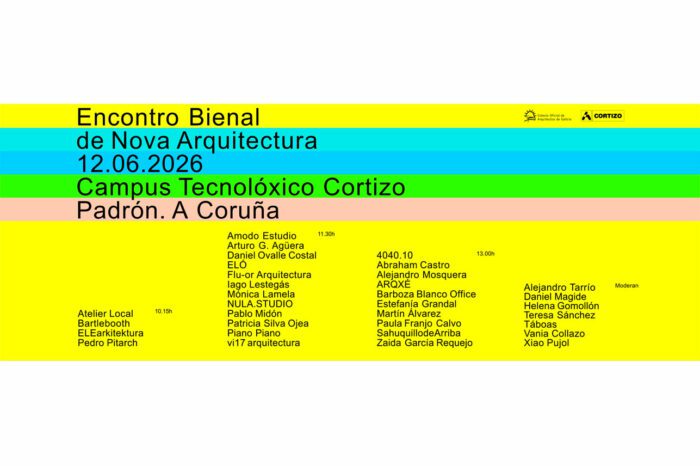
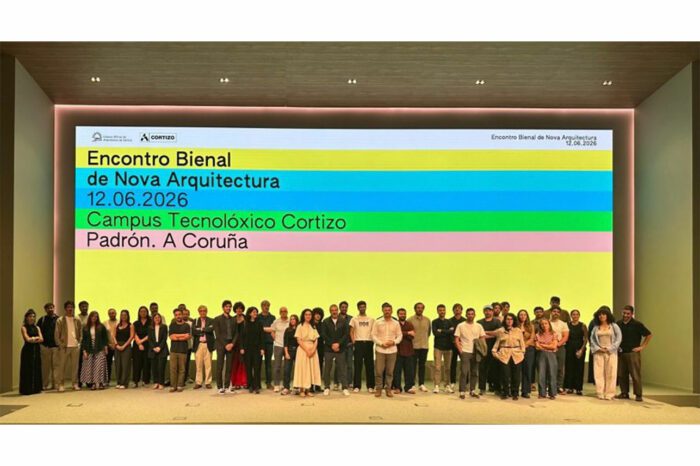
On June 12th, we travelled to Padrón to take part in the Encontro Bienal de Nova Arquitectura, organised by COAG and Cortizo at the Cortizo Technological Campus.
The event was structured around presentations, panel discussions and networking sessions that addressed topics such as management models in emerging practices, the internationalisation of the profession and the role of younger generations in architectural decision-making. At the same time, it gave us the opportunity to connect with many young studios from across Spain and Portugal with whom we share both a generation and common concerns, as well as finally meeting in person many people we had only known from afar.
The gathering brought together young architectural practices from different parts of the Iberian Peninsula to discuss how we practice architecture today, the new models of practice that are emerging and the challenges we share as a generation. Beyond the talks and presentations, Piano Piano took part in the panel discussion Industrialised Construction and Craftsmanship: Challenges and Opportunities, alongside Eló and Amodo Estudio, moderated by Alejandro Tarrío.
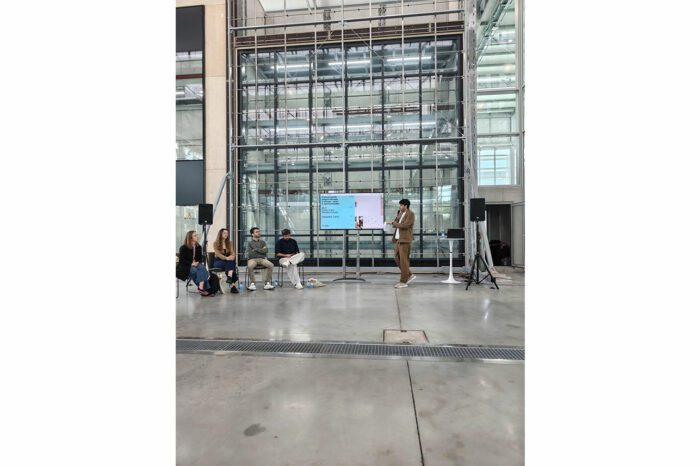
Our position throughout the conversation was quite clear: we do not believe that industrialisation and craftsmanship should be understood as opposing worlds. On the contrary, there is much that architecture can learn from industry: better planning, stronger coordination, less improvisation, greater control over time and resources, and a stronger environmental awareness. At the same time, we believe that craftsmanship remains a fundamental value because it is deeply connected to people, to the knowledge accumulated through tradition and to the identity of each place.
Perhaps for this reason, we are concerned when industrialisation becomes associated solely with repetition and standardisation. When speed and profitability become the only objectives, we run the risk of producing buildings that increasingly resemble one another, regardless of where they are built. It is something we frequently observe in our cities: developments that could belong anywhere because they no longer respond to the specific qualities of their surroundings.
In our own practice, we work primarily on renovation projects and small-scale interventions, contexts in which it is difficult to apply closed systems or overly standardised solutions. We are interested in working with what already exists, with the limitations and opportunities of each place, and with the people who ultimately build the projects. This is where craftsmanship continues to play a central role.
Even so, we see many of the tools associated with industrialisation as valuable. More than the idea of manufacturing buildings as products, we are interested in its potential to professionalise processes, define projects more clearly from the outset, improve coordination between all stakeholders and reduce errors during construction, ultimately helping us build better.
One of the most interesting aspects of the event was seeing how place continues—fortunately—to shape good architecture. Listening to our Galician colleagues highlighted the extent to which climate, light and landscape influence the way they design. While in the north the focus is often on capturing light, protecting against rain and creating bright, welcoming spaces, in the Mediterranean we constantly work with shade, filters, transitional spaces, vegetation and solar control.
For this reason, we believe that industrialisation must be capable of adapting to different contexts. An architecture conceived for Galicia should not be the same as one designed for Valencia. If industrialisation is to become part of the future of construction, it must find ways to incorporate these differences rather than erase them. In a world where we increasingly need to make the global local, why not allow craftsmanship to learn from industrial processes in terms of organisation, order, efficiency and effectiveness, while still enabling projects to remain unique and deeply rooted in their context?
We left the discussion with one idea that ran through the entire conversation: perhaps the challenge is not choosing between industry and craftsmanship, but learning how to combine the best of both worlds. To take advantage of the organisation, efficiency and precision offered by industry without losing what makes every project, every city and every territory unique.
We would like to thank COAG and Cortizo for inviting us to be part of this exchange, and for the opportunity to share the panel with professionals who, from different perspectives, are helping to redefine the way we conceive and build architecture today.