

Drawing Architecture: The Role of Architectural Drawings in the Design Process
- inspiration
- /
- tales
- /
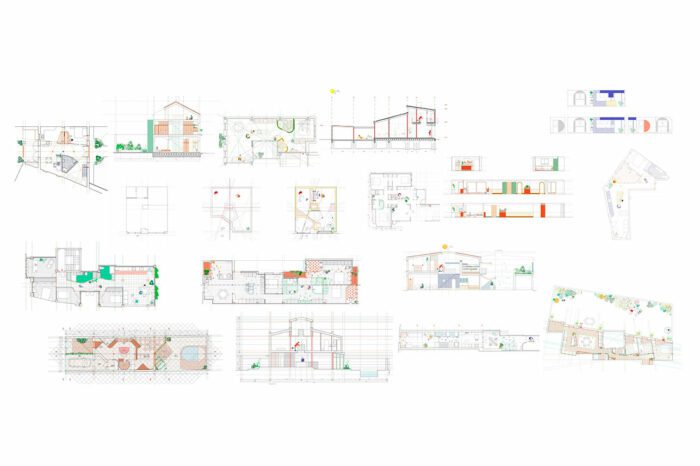
What is an architectural drawing and what is it used for?
An architectural drawing is the most fundamental tool of representation in architecture. It allows us to communicate how an architectural element should be built, regardless of its scale, through a common language shared by everyone involved in a project: the architectural team and other specialists we collaborate with, the different trades responsible for construction, and even the final user, who can understand what a space will be like before it is built.
Architectural drawings as a tool for thinking and designing architecture
Architectural drawings are also an exciting tool because they allow us to imagine a space before it exists. They develop alongside the project itself, taking shape from the moment an idea begins to form in the mind.
Regardless of the medium used to produce them, drawings provide the foundation for communicating information, expressing ideas, explaining a project and conveying the qualities of a space.
Through lines, scales and proportions, drawings organise relationships between spaces, circulation, materials, structures and building services, making it possible to anticipate both how a project will be built and how it will be inhabited.
In this sense, drawing is a process of analysis and decision-making in which every line defines dimensions, limits and relationships. Drawings are working tools that connect ideas, details and construction — or, in other words, thought, technique and execution. They are where architecture begins to take shape in a precise and conscious way.
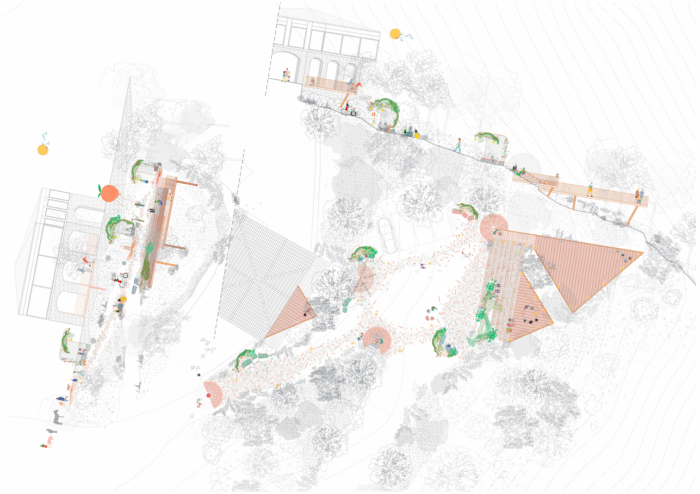
How we use drawings when working with our clients
When we work with a client we know personally — as is the case in most of our projects — we like to approach architecture in a way that is, in some sense, educational. We aim to create a dialogue where ideas can be exchanged freely rather than imposed by either side. Drawings are one of the tools that make this possible.
Our first meetings almost always begin with drawings: plans, elevations and sections. Physical models or highly developed three-dimensional proposals with specific material solutions rarely appear at this stage.
Instead, we develop drawings that gradually incorporate more information and greater levels of detail as conversations evolve.
The importance of plans, elevations and sections in architectural design
We like to start with drawings because they allow us to focus on dimensions, proportions, numerical relationships and geometry.
The initial moment of thinking about a project, when a drawing is still little more than a diagram, is particularly beautiful because it concentrates what is essential: an intention.
At this stage, more imaginative or sensory elements may also emerge, helping to generate enthusiasm and build a shared narrative. Yet they always revolve around a concrete drawing and never overshadow it.
As decisions are incorporated into the project, the drawing becomes increasingly precise: spaces acquire the dimensions required by their intended use and a structural, constructive and dimensional logic begins to emerge.
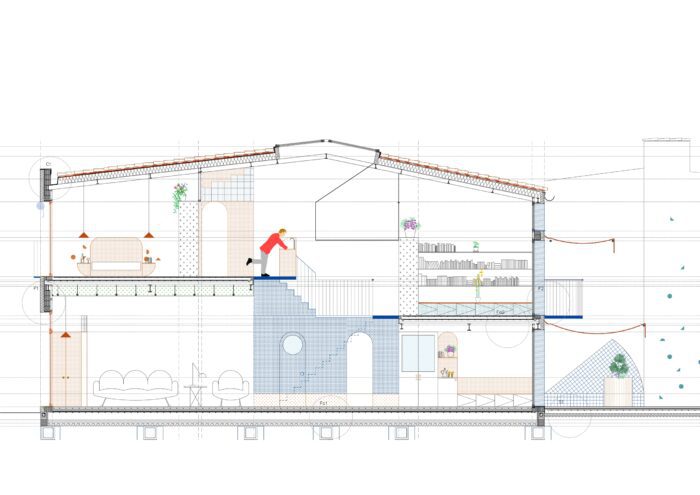
Drawings as layers of information throughout the design process
We often describe each project as an additive process in which new layers are gradually superimposed, much like the layers of an onion, as complexity increases and more people become involved.
This development is always built upon a solid foundation and unfolds step by step, almost like a recipe that is continuously refined throughout the process.
Within this framework, drawings become the tool that allows us to organise, record and make visible these different layers. They help structure the decisions that shape a project and provide a point of reference whenever changes need to be made or questions need to be resolved, whether they concern the way a space is experienced, construction details, structural systems or building services.
We share a design philosophy based on perseverance and analytical thinking, seeking to arrive at the conceptual essence of each project. Through drawing, this analysis is translated into spatial relationships, proportions and sequences that anticipate architecture before it is built.
In this way, a process emerges that defines our approach to architecture and guides us, with precision and coherence, towards the solutions we believe are appropriate.
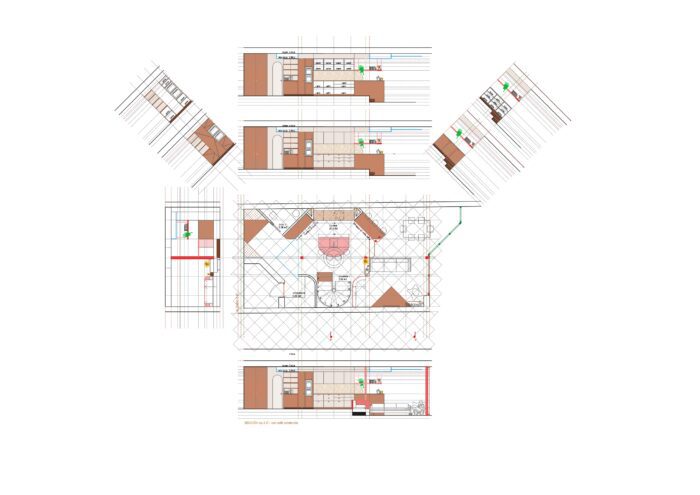
Drawings as a reflection of a way of understanding architecture
Drawings are produced differently depending on their purpose and on who will read them.
A drawing is much like a text: its tone changes according to its audience. This is why layers of information are so important.
A private client, for example, does not need to know the exact route of every service installation. What matters is understanding where electrical outlets and switches will be located, because this helps them imagine everyday situations: where to place a floor lamp beside a favourite reading chair or from which worktop they will prepare a meal.
The same drawing can therefore communicate different things depending on which layers of information are visible.
A drawing can be beautiful and easy to understand. It can be confusing and unreadable. Or it can be the opposite.
In a world increasingly dominated by images — and by the illusions that images can sometimes create — drawings provide us with certainty and answers. A good drawing supports good architecture, just as a drawing can reveal the weaknesses of a poor project.
For this reason, we strive to produce drawings that are beautiful but, above all, clear, precise and easy to read.
Even in the earliest stages of a project, our drawings should reveal two concerns. On the one hand, an interest in how a space will be lived in: how it will be occupied, experienced and moved through. On the other, an interest in construction itself: details and construction systems represented as faithfully as possible while remaining intuitive and easy to understand.
Ultimately, a drawing says something about the person who made it. It reflects their obsessions, priorities and way of thinking.
Every architect has a particular way of understanding the world and approaching reality, and this inevitably becomes visible in the way they draw and communicate ideas.
One could even argue that the act of drawing is a kind of manifesto: a concise expression of how we think and how we understand architecture.